
Do You Need to Count Calories to Lose Weight? What Really Matters
To count or not to count, that is the question: whether to track every calorie consumed and account for every bite, or to take food as it comes and focus instead on nutritious, minimally processed foods.
Okay, maybe Shakespeare wasn’t talking about calorie tracking, but it’s a question a lot of people trying to lose weight eventually ask: do you need to count calories to lose weight?
And my answer? Well, yes and no. Or no and yes? Let me explain.
Let’s start with the very basics of weight loss and weight gain.
For an individual to lose weight, they need to consume fewer calories than their body uses to maintain its current weight. This is known as a calorie deficit. To gain weight, they need to consistently consume more calories than their body uses, creating a calorie surplus.
Here is a simple example. If my body uses around 2,000 calories per day to maintain my current weight and I consistently eat less than 2,000 calories, my body has to make up that energy difference using energy stored within the body. Over time, this can lead to weight loss.
On the other hand, if I consistently consume more than 2,000 calories per day, I would be in a caloric surplus, which, over time, can lead to weight gain. If I am resistance training, eating enough protein, and recovering properly, some of that weight gain can be muscle. However, a calorie surplus can also result in additional body fat.
So, if calories ultimately determine whether your body is in a deficit or surplus, do you need to count calories to lose weight?
Not necessarily.
And that distinction is where things start to get interesting.
If you want an estimate of how many calories your body may need to maintain, lose, or gain weight, you can also check out the Tefo Fitness Calorie Calculator.
Can You Lose Weight Without Counting Calories?
It is absolutely possible to lose weight without counting a single calorie. However, if you are not tracking your intake, you still need a way to control how much energy you consume. That can mean paying closer attention to your portions, prioritizing protein, including plenty of vegetables, choosing mostly whole or minimally processed foods, and being consistent with that structure day in and day out.
None of those things magically cause weight loss on their own. What they can do is make it easier to eat fewer calories without having to weigh, measure, and log every single thing you eat. You still need a calorie deficit to lose weight. You just do not necessarily need to count calories to create one.
Then Why Count Calories?
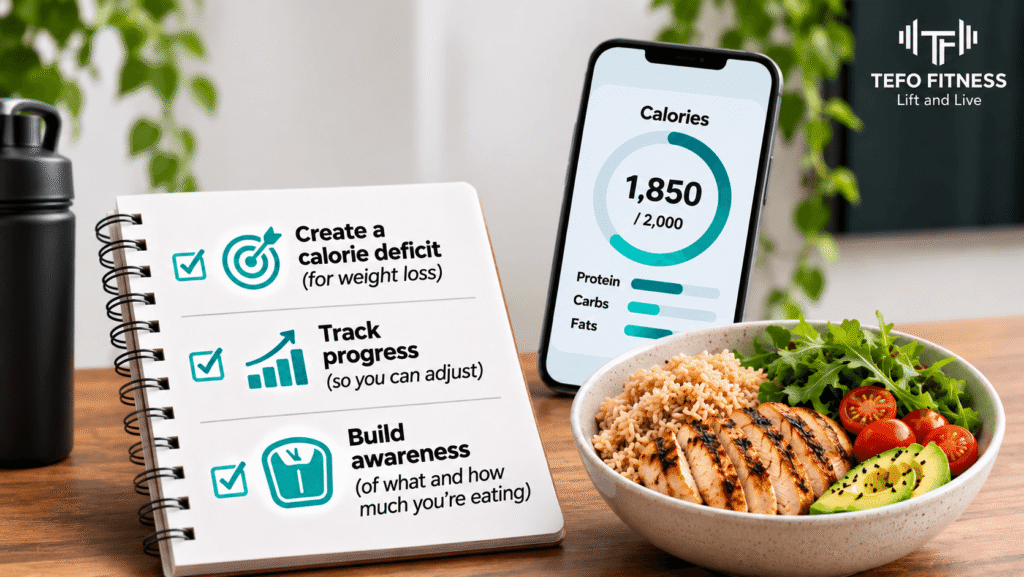
As I mentioned earlier, to lose weight you need to be in a calorie deficit. While it is absolutely possible to create that deficit without tracking calories, it can be much harder to know how much you are actually eating and whether you are consistently staying in that deficit when you are not keeping track.
Think of it like the money in your bank account and your monthly budget. If you have $2,000 every month to pay your bills, expenses, and everything in between, but you rarely check your account or keep track of what you are spending, there is a good chance you could overspend without realizing it.
Calories can work in a similar way.
You could be eating mostly whole foods, vegetables, and protein and still consume more calories than your body needs. Portions can add up. Snacks can add up. Oils, sauces, drinks, and other foods that may seem small can add up too. Before you know it, you may not be in the calorie deficit you thought you were.
That is one of the benefits of tracking. Recording your food intake can give you a clearer picture of how much you are actually consuming, and research on dietary self-monitoring has found that regular monitoring can support weight-loss efforts (Berry et al., 2021).
Tracking can also become useful when your progress starts to slow down. As you lose weight, your energy needs can change, and physiological adaptations to weight loss can reduce total energy expenditure over time (Rosenbaum, 2023). That means the amount of food that helped you lose weight at the beginning may eventually produce a smaller deficit than it once did.
If you are tracking, you have data you can look back at. Instead of simply thinking, “I guess I need to eat less,” you can see approximately how much you have been eating, look at what your body weight has been doing, and make a small adjustment from there.
Without that information, you can still make changes, but there is naturally more guesswork involved.
And I know how frustrating that can be. You can feel like you are doing everything “right,” eating nutritious foods, prioritizing protein and vegetables, and still not seeing the scale moving the way you expected.
So, do you need to count calories to lose weight? No. But counting calories can give you a much clearer picture of what you are eating and make it easier to identify what may need to change when your progress changes.
Should Beginners Count Calories?
For someone just beginning their weight-loss journey, I actually recommend counting calories for at least a while. Not because I think you should spend the rest of your life weighing every piece of food and logging every meal, but because tracking can be an incredibly useful learning tool. For beginners asking, “Do you need to count calories to lose weight?” I think tracking for a period of time can be especially useful as a learning tool.
When you start paying attention to calories, portion sizes, protein, carbohydrates, fats, and how calorie-dense different foods are, you begin to understand your food much better. Foods you thought were low in calories may surprise you, portions may be larger or smaller than you expected, and you start getting a better idea of what a meal that aligns with your goals actually looks like.
The goal is not necessarily to become dependent on calorie tracking. The goal is to learn enough from it to eventually make more informed estimates, even when you are not tracking.
So, Should You Count Calories?
Honestly, that is the goal of Tefo Fitness: to teach you how to use the best tools available to reach your goals without feeling like you have to depend on an app, calculator, or any other external tool forever. We want you to become more informed so you can make decisions that work best for you. Ultimately, if you’re asking, “Do you need to count calories to lose weight?” the answer depends less on whether tracking is mandatory and more on whether it helps you understand and manage your eating habits.
Check out our other articles to learn more about fitness, wellness, nutrition, and training. Here at Tefo Fitness, we appreciate every single person who has taken the time to read one of our blogs, use our free Calorie Calculator or 1-Rep Max Calculator, or simply give us a like or follow on social media. Thank you. We will keep working hard to provide you with practical, evidence-based content and resources to support your fitness journey.
So, do you need to count calories to lose weight? No. But counting calories, at least for a period of time, can be a great way to learn more about the foods you eat, understand your portions, and build the knowledge you need to make more informed choices even when you are no longer tracking.
Lift and Live!
References
Berry, R., Kassavou, A., & Sutton, S. (2021). Does self-monitoring diet and physical activity behaviors using digital technology support adults with obesity or overweight to lose weight? A systematic literature review with meta-analysis. Obesity Reviews, 22(10), e13306. https://doi.org/10.1111/obr.13306
Rosenbaum, M. (2023). Appetite, energy expenditure, and the regulation of energy balance. Gastroenterology Clinics of North America, 52(2), 311–322. https://doi.org/10.1016/j.gtc.2023.03.004
Get Your Free 8-Week Training Program
Build genuine strength and establish consistent workout habits with our science-backed training roadmap. Enter your email below to receive the complete 9-page PDF protocol in your inbox and get instant download access.
Support Free Fitness Education
Enjoying our free fitness resources? Help us keep fitness education accessible to everyone. Your support is always optional and appreciated.
Support Tefo Fitness