
Progressive Overload for Beginners: How to Actually Make Progress
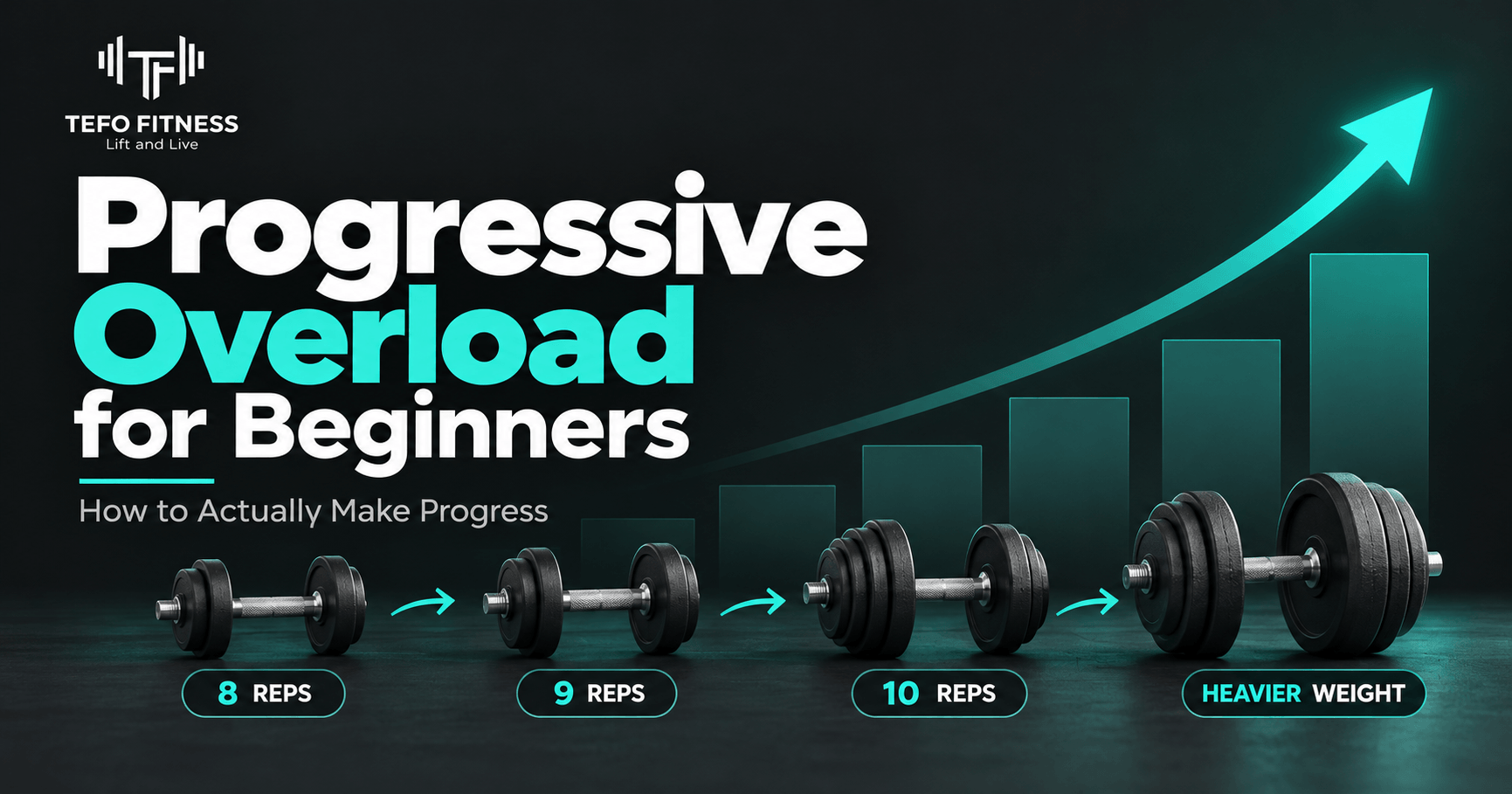
There are a few important principles we must understand if we want to make progress in the gym. However, I do not want to dive into all the science behind it. I want to discuss one specific thing that is often overlooked or overcomplicated. Unfortunately, this is common in the fitness world: overcomplicating information and/or principles. Progressive overload for beginners can sound more complicated than it actually is.
First, we need to understand that it is impossible to make progress if we are not consistent with our training and nutrition. So, for the sake of the argument, we are going to assume that consistency is not the problem, yet we are still not seeing meaningful changes in our strength, muscle, or the way our body looks.
Then what is happening? And why is it starting to feel like we are “wasting our time” in the gym?
Important caveat: working out has tremendous health benefits beyond just how we look, so even if you are not seeing significant changes on the outside, your heart, bones, and joints are much happier with you.
But let’s get back on track. We are consistent but seeing minimal progress. Why?
What Is Progressive Overload?
Progressive overload!
But what is progressive overload?
In simple terms, progressive overload means gradually making your training more challenging over time. The easiest ways to do that are to lift a little more weight, do more repetitions with the same weight, or sometimes add another set. The point is that, over time, your body needs a reason to continue adapting.
Sounds pretty straightforward, right?
I just gotta lift more every week!
In theory, yes. However, we are not Superman or Wonder Woman. We cannot simply keep adding more and more weight every training session, week after week, month after month, year after year, decade after decade, century after century!
Understanding progressive overload for beginners is especially important because progress can happen quickly at first, which can make it seem like adding more weight every workout is the only way to keep improving. That is not always the case.
Progressive Overload Example: What Does It Actually Look Like in a Real Workout?
Now that we have a better understanding of the term, let’s put it into a real context.
I have been training for over 10 years, and as an experienced lifter, making big jumps in weight is no longer easy. It takes time, patience, consistency, and a clear understanding of progressive overload.
In my current training, one of the ways I approach progression looks something like this:
Week 1: 100 lbs × 8 repetitions × 4 sets
Week 2: 100 lbs × 9 repetitions × 4 sets
Week 3: 100 lbs × 10 repetitions × 4 sets
Assuming I was able to complete all four sets with the target number of repetitions and good form, then:
Week 4: 105 lbs × 8 repetitions × 4 sets
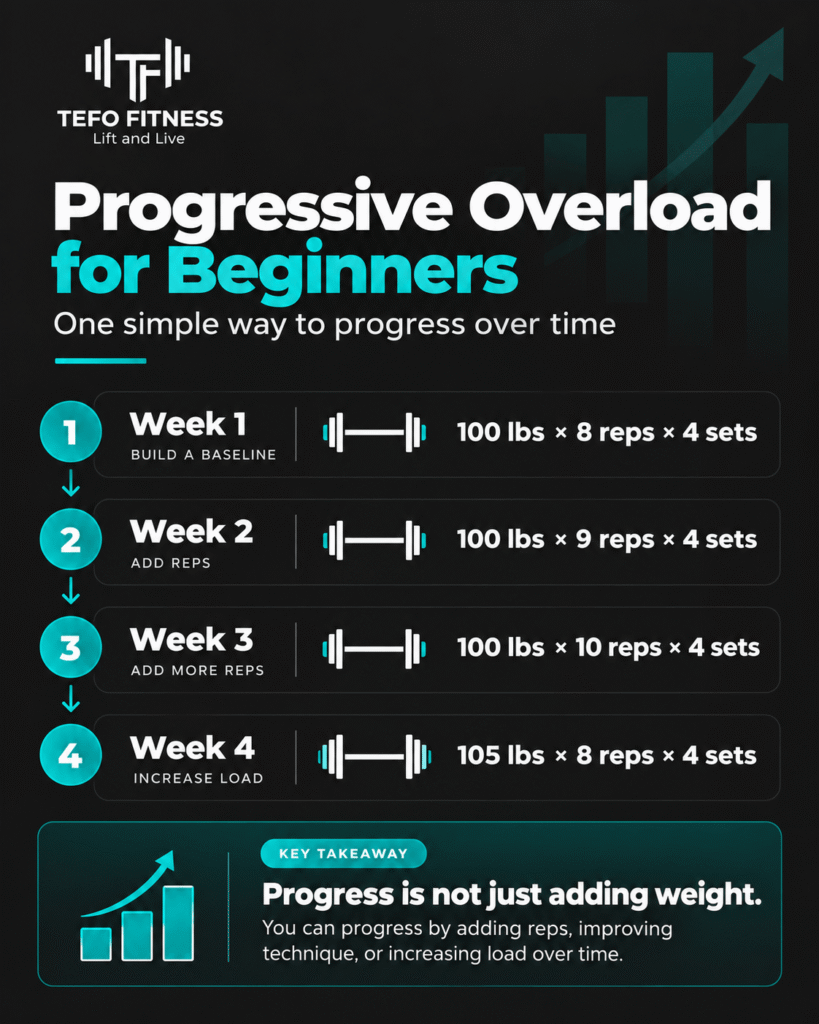
Looking at this progressive overload example, you might say, “It took you four weeks just to add 5 pounds?!”
Well, not exactly.
During Week 1, I completed 3,200 pounds of total volume load: 100 × 8 × 4. In Week 2, that increased to 3,600 pounds, and by Week 3, I completed 4,000 pounds.
That means I performed 25% more total volume in Week 3 than in Week 1 without even increasing the weight.
Then something interesting happens in Week 4.
When I increase the weight to 105 pounds but bring the repetitions back down to eight, my total volume becomes 3,360 pounds. Technically, that is less total volume than Week 3, but I am now handling a heavier load.
This is an important distinction because progressive overload is not simply about increasing a single number in every workout.
Progressive overload can come from doing more repetitions with the same weight, lifting more weight, or adding productive sets when appropriate. Better technique and control are also signs of progress, even if they do not increase the numbers in your training log.
Research supports progressive resistance training as an effective way to continue improving strength and muscle mass over time, and shows that complex training methods are not necessary to make progress (Currier et al., 2026).
For someone who has been training consistently for a while, gradually manipulating repetitions, load, and training volume provides a practical and sustainable way to progress without trying to force a weight increase every single week.
Even with this approach, there is no guarantee that every week will be better than the one before.
Sleep, nutrition, stress, recovery, and just having an off day can all affect performance.
The goal is not to break a record every workout. The goal is to look at your training over several weeks or months and see that, overall, you are able to do more than you could before.
That is how you make progress in the gym over time.
Common Progressive Overload Mistakes
One of the biggest mistakes people make is assuming that the rate at which they progress when they first start training is the rate at which they should continue progressing forever.
When someone is brand-new to the gym or comes back after a long break, progress can happen very quickly.
Part of that improvement is muscular, but part of it is also your nervous system getting better at performing the movement. You become more coordinated, your technique improves, and your body gets better at recruiting the muscles needed for that particular exercise.
Research on resistance training has shown that neural adaptations and improvements in coordination contribute substantially to strength development, especially during the earlier stages of training (Del Vecchio et al., 2024).
Think about someone doing a squat for the first time.
Maybe during Week 1, they use 50 pounds, and by Week 3, they use 70 pounds.
Did they suddenly build enough muscle in two weeks to become 40% stronger?
Probably not.
Some of that improvement came from simply learning how to squat better: finding a comfortable stance, controlling the weight, bracing properly, and becoming more confident with the movement.
That is great progress, but eventually those rapid jumps slow down.
As you become more experienced, your body has already made many of those early adaptations, and adding another 5 or 10 pounds becomes much harder. Research comparing training experience also shows that more highly trained individuals generally require more careful adjustments to training, as adaptations become harder to achieve with increasing experience (Santos et al., 2023).
This is where people often get frustrated.
If your only definition of progressive overload is “I need to add weight every workout,” you will eventually reach a point where you cannot do it. Then you might think you have reached a plateau in your gym progress or that your program is no longer working.
Instead, give your body time to actually adapt.
Maybe this week you can lift 100 pounds for 8 reps. Next week you get nine. A week later, you get ten.
Once you can consistently perform the top end of your rep range with good technique and the appropriate level of effort, then increase the weight and start building the repetitions back up again.
This does not guarantee that you will never reach a workout plateau. Plateaus are a normal part of long-term training.
But it gives you a much more sustainable way to approach progressive overload rather than constantly chasing heavier weights before your body is ready for them.
The Bottom Line on Progressive Overload
Progressive overload does not have to be complicated. In fact, it can be simple if you have a plan.
Understanding how to make progress in the gym can be challenging, but with the right tools, you will see that fitness is not as complicated as it may seem or feel.
If you want those tools, keep reading our blog to learn more about fitness.
If you want someone to guide you through your fitness journey, we also offer personalized coaching for training and nutrition.
If you just want to follow a program that works, check out our free programs, which you can easily download and keep forever.
Thank you for taking the time to read this blog, but more importantly, thank you for starting to make choices to improve your fitness.
Lift and Live!
References:
Currier, B. S., D’Souza, A. C., Fiatarone Singh, M. A., Lowisz, C. V., Rawson, E. S., Schoenfeld, B. J., Smith-Ryan, A. E., Steen, J. P., Thomas, G. A., Triplett, N. T., Washington, T. A., Werner, T. J., & Phillips, S. M. (2026). American College of Sports Medicine position stand: Resistance training prescription for muscle function, hypertrophy, and physical performance in healthy adults: An overview of reviews. Medicine & Science in Sports & Exercise, 58(4), 851–872. https://doi.org/10.1249/MSS.0000000000003897 PubMed
Del Vecchio, A., Enoka, R. M., & Farina, D. (2024). Specificity of early motor unit adaptations with resistive exercise training. The Journal of Physiology, 602(12), 2679–2688. https://doi.org/10.1113/JP282560 PubMed
Santos, P. D. G., Vaz, J. R., Correia, J., Neto, T., & Pezarat-Correia, P. (2023). Long-term neurophysiological adaptations to strength training: A systematic review with cross-sectional studies. Journal of Strength and Conditioning Research, 37(10), 2091–2105. https://doi.org/10.1519/JSC.0000000000004543 PubMed
Get Your Free 8-Week Training Program
Build genuine strength and establish consistent workout habits with our science-backed training roadmap. Enter your email below to receive the complete 9-page PDF protocol in your inbox and get instant download access.
Support Free Fitness Education
Enjoying our free fitness resources? Help us keep fitness education accessible to everyone. Your support is always optional and appreciated.
Support Tefo Fitness