How to Start Going to the Gym: What to Do on Your First Day
The gym can appear to be an intimidating place. I mean, you walk in and see what feels like a thousand machines you have no idea how to use, a bunch of people who are in very good shape and might seem intimidating, and yeah, it is probably a little bit smelly.
Meanwhile, you are walking in feeling insecure, full of doubts, and already thinking that maybe you do not belong there. Maybe you should have just stayed home and watched another episode of your favorite show. This is your free time, after all, and now you are spending it doing something you might not even want to do, in a place you really do not want to be.
If you are trying to figure out how to start going to the gym, that feeling is completely understandable.
But what if I told you it is really not that bad?
The machines are usually much simpler to use than they first appear. The people who seem intimidating are probably not worried about what you are doing at all. Most people are focused on their own workout, and some may even be more than happy to help if you ask.
And the smell? Well… that depends on the gym and how crowded it is. It should not be stinky, but at the end of the day, it is an enclosed space filled with people exercising. There is only so much you can do besides proper ventilation and regular cleaning, which a good gym should already be doing.
So, if your first day at the gym feels a little overwhelming, that is okay. Let’s make it a lot simpler.
What Should You Do on Your First Day at the Gym?
The first thing you should do before you even make your way to the gym is have a plan. Know what you are intending to do.
If you just walk in with no plan or idea of what you want to accomplish, it is very easy to feel overwhelmed and overstimulated. Even something as simple as saying, “Tomorrow when I go to the gym, I am going to train my legs,” already gives you some direction. Once you get there, instead of looking around at everything in the gym, you can focus on finding the machines and exercises that work your legs.
That is already much better than walking in with absolutely no plan.
However, there is an even better way to approach your first gym workout: have an actual training program ready to follow.
Yes, having a personal trainer or someone with more experience there to guide you would be ideal. But for the sake of this article, let’s say it is just you.
If you can start your first day with a training program already in place, you can remove a lot of the guesswork at the beginning.
You will know which exercises or machines you are looking for, how many sets and reps to do, how long to rest between sets or exercises, and roughly how long the workout should take. If you have also done a little bit of research beforehand and looked up the exercises in your program, you can walk in with at least a basic idea of how each movement is supposed to be performed.
Having all of that information ahead of time can give you much more confidence and quiet some of the noise in your head. Instead of walking around overthinking every decision, you can focus on finding the equipment, following the routine, and getting through your workout one step at a time.
What Should Your First Gym Workout Look Like?
Your first workout should be simple, and your goal should not be to end the workout gasping for air and feeling completely exhausted.
Going all-out on your first day could leave you much more sore and fatigued than necessary over the next few days. That can make going back to the gym feel even less appealing, which is the exact opposite of what we are trying to accomplish when building the foundation for consistency (Mágero et al., 2026).
Your first few workouts should be about introducing yourself to the main movements in your routine and focusing on learning technique and execution rather than trying to break any gym records.
Think about it this way: you need to learn how to walk before you can run.
A simple first-day workout could look like this:
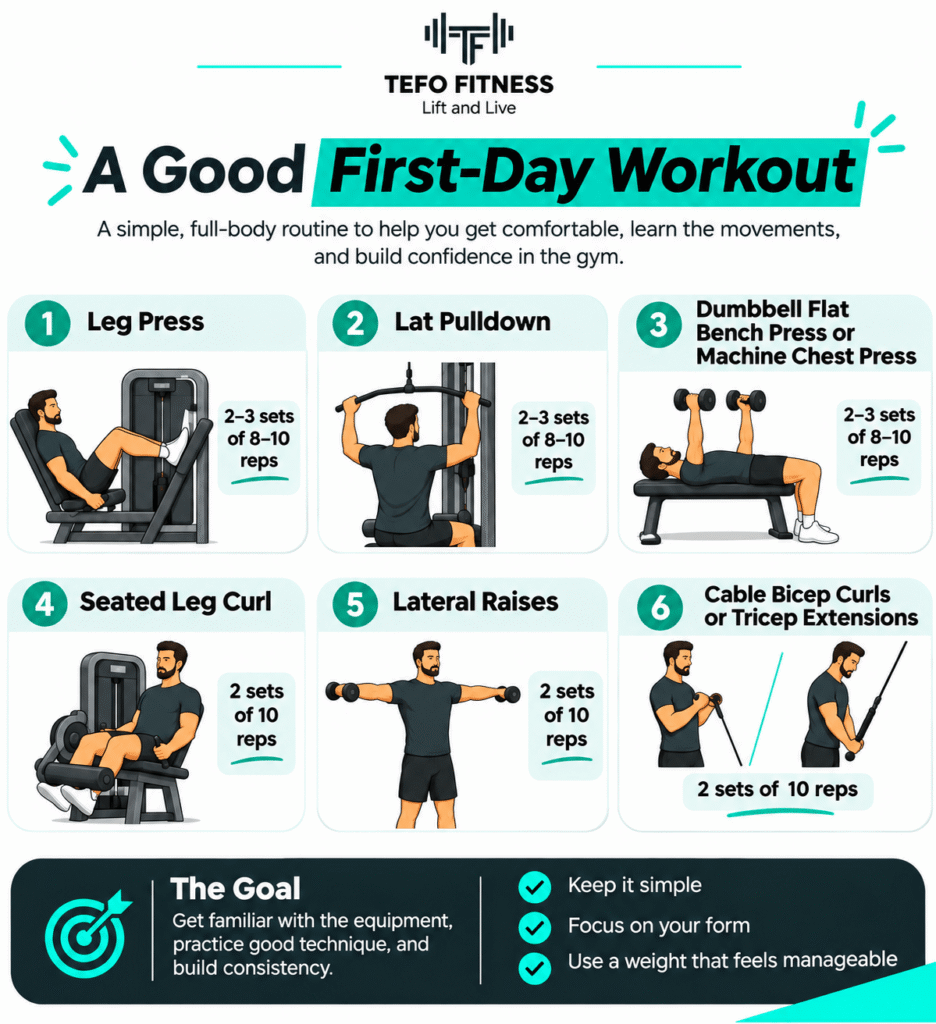
Rest about 2 minutes between sets.
This gives you a simple full-body workout without making your first day unnecessarily complicated. The goal is to learn the movements, understand how the equipment works, and start practicing good technique.
How much weight you should lift is going to be different for everyone. For now, choose a weight that allows you to complete every set and rep with consistent technique while still feeling like you could have done a few more good reps if you absolutely had to.
During your first few weeks in the gym, getting comfortable matters more than proving how strong you are. Learn your routine. Learn how to set up the equipment. Learn how each exercise should feel. Most importantly, work on being able to repeat those movements with good, consistent technique.
Once that starts becoming more comfortable and consistent, then we can start paying more attention to training intensity and progressive overload (Currier et al., 2026).
What Should You Bring to the Gym for the First Time?
Honestly, you do not need much.
You do not need the perfect gym outfit, a massive gym bag, five different supplements, a lifting belt, straps, sleeves, or a gallon jug of water just because you have seen other people carrying them around.
For your first day, keep it simple.
Bring comfortable clothes that allow you to move freely, shoes that are appropriate for the type of training you are doing, some water, and your phone so you can follow your workout and look up an exercise if you need to.
Headphones are completely optional, but I personally think a good playlist can make almost anything better.
Depending on the gym, you may also need a lock if you plan on using a locker.
That is really it.
Remember, the goal is to remove as many barriers as possible. You are already doing something new. There is no reason to make getting ready for the gym another complicated process.
What Should You Avoid on Your First Day at the Gym?
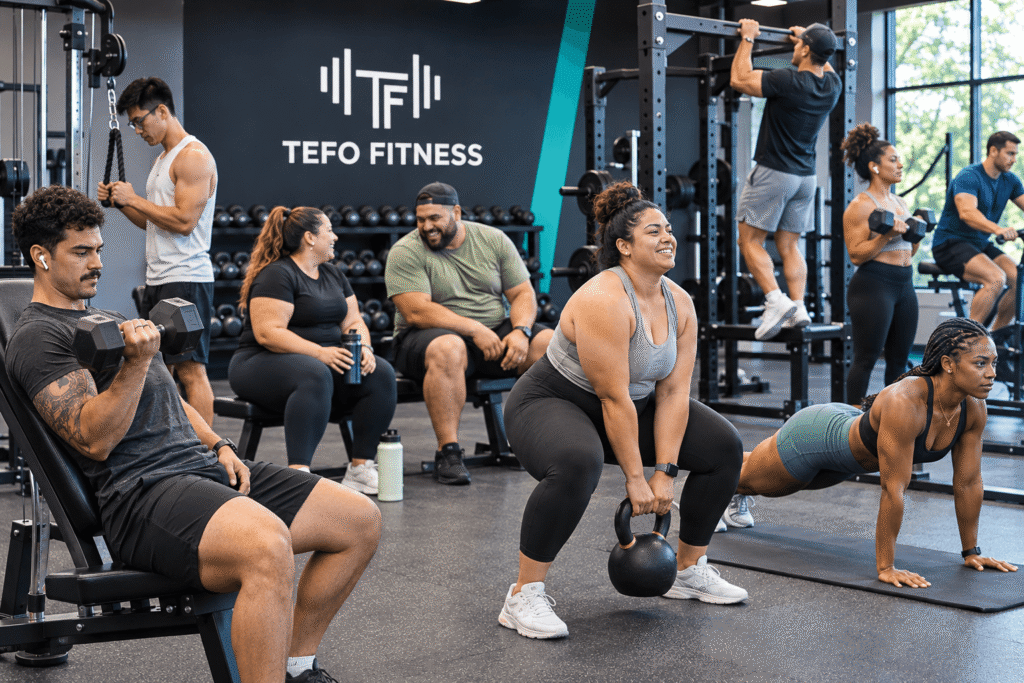
The biggest advice I can give you here is to avoid doing too much. There is no need to get on every machine you see, to follow whatever the strongest person in the gym is doing, or to try to lift every dumbbell you see just to see how much weight you can lift.
You definitely do not need to leave the gym barely able to walk just so you can say you had a good workout.
And please do not completely change your routine halfway through because you saw someone doing an exercise that looked cooler than the one you had planned. Follow your program. If a machine is taken, you can wait, move to another exercise in your routine, or find an appropriate alternative. The entire workout is not ruined because everything did not go exactly according to plan.
You are going to make mistakes. You might adjust a machine incorrectly the first time. You might grab dumbbells that are too heavy and have to put them back. You might have to watch a quick video to remind yourself how an exercise works. None of that matters. You are learning.
Your goal on day one is not to look like somebody who has been training for ten years. Your goal is to become a little more comfortable than you were when you walked through the door.
How to Start Going to the Gym: Bottom Line
If you are someone who wants to start going to the gym but feels intimidated about it, first know that your feelings are okay. But also know that, as with everything in life that you approach for the first time, you will be nervous.
If you have a plan and approach it with a clear idea of not only what to do, but also an understanding that you are about to learn new things, you can accept that it won’t be perfect at first and that you will make mistakes.
You will be okay. In fact, you will be more than okay. You will be great because you are starting to put more effort into your health, fitness, and, as a result, your quality of life.
The gym will probably feel unfamiliar at first. Then you will learn where the equipment is. You will learn how to adjust the machines. You will start recognizing exercises. You will figure out what weights you normally use. Eventually, something that once felt intimidating will simply become part of your routine.
And that is really what we are trying to accomplish.
The most important thing you can do as a beginner is not find the most advanced workout or the most scientifically perfect exercise. It is to find a way of training that you can consistently come back to. Current resistance-training evidence continues to support that consistency matters far more for the average person than making a program unnecessarily complicated (Currier et al., 2026).
So do not put pressure on yourself to have an amazing first workout.
Have a first workout that makes you willing to come back for a second one.
And if having a routine ready would make that first day a little easier, check out our free training programs and choose one that fits where you are right now.
Lift and Live.
References
Currier, B. S., D’Souza, A. C., Fiatarone Singh, M. A., Lowisz, C. V., Rawson, E. S., Schoenfeld, B. J., Smith-Ryan, A. E., Steen, J. P., Thomas, G. A., Triplett, N. T., Washington, T. A., Werner, T. J., & Phillips, S. M. (2026). American College of Sports Medicine position stand: Resistance training prescription for muscle function, hypertrophy, and physical performance in healthy adults: An overview of reviews. Medicine & Science in Sports & Exercise, 58(4), 851–872. https://doi.org/10.1249/MSS.0000000000003897
Mágero, N. R. L., Helito, P. V. P., & Bordalo, M. (2026). Imaging characterization and differential diagnosis of delayed-onset muscle soreness (DOMS) in athletes. Skeletal Radiology. https://doi.org/10.1007/s00256-026-05292-2
Get Your Free 8-Week Training Program
Build genuine strength and establish consistent workout habits with our science-backed training roadmap. Enter your email below to receive the complete 9-page PDF protocol in your inbox and get instant download access.
Support Free Fitness Education
Enjoying our free fitness resources? Help us keep fitness education accessible to everyone. Your support is always optional and appreciated.
Support Tefo Fitness